Jul 3, 2026News & Insights
What Is Important When Considering Business Gifts?
Effective business gifts prioritize practicality, subtle branding, and compliance, helping strengthen professional relationships while creating lasting brand value.

What Is Important When Considering Business Gifts?
Are you tired of spending your annual marketing budget on corporate tokens that your clients leave behind on event tables or quietly throw away? Selecting items without a clear strategy makes your gifts feel cheap, thoughtless, and completely uninspired.
You can choose the best business gifts by matching the product’s daily utility to the recipient’s professional routine and maintaining strict compliance alignment. Select premium retail-quality essentials like double-wall vacuum insulated flasks or minimalist tech accessories that feature subtle, understated custom branding.

I started my career working directly on a noisy printing factory floor, managing production setups and checking layout proportions by hand under tight schedules. That industrial experience taught me that physical merchandise is never just a box to tick; it is a direct extension of your corporate identity and brand standards. Later, I established Latitude Experience Pte Ltd because I wanted to help marketing managers move away from lazy logo-slapping habits. I know that a considered gift acts as a physical bridge of human understanding in a crowded digital marketplace. Let us explore the core strategic principles and corporate rules that turn simple corporate giveaways into powerful, long-lasting relationship-building tools.
What Is the 5 Gift Rule?
Do you struggle to balance your employee rewards budget, often finding that packing a gift box with random items feels cluttered and lacks a clear theme? Distributing a messy pile of cheap promotional knick-knacks dilutes your corporate message completely.
The 5 gift rule is a structured curation framework used to design balanced corporate gift boxes by selecting exactly one item from five distinct functional categories: something they want, something they need, something to wear, something to read, and a special unexpected token.
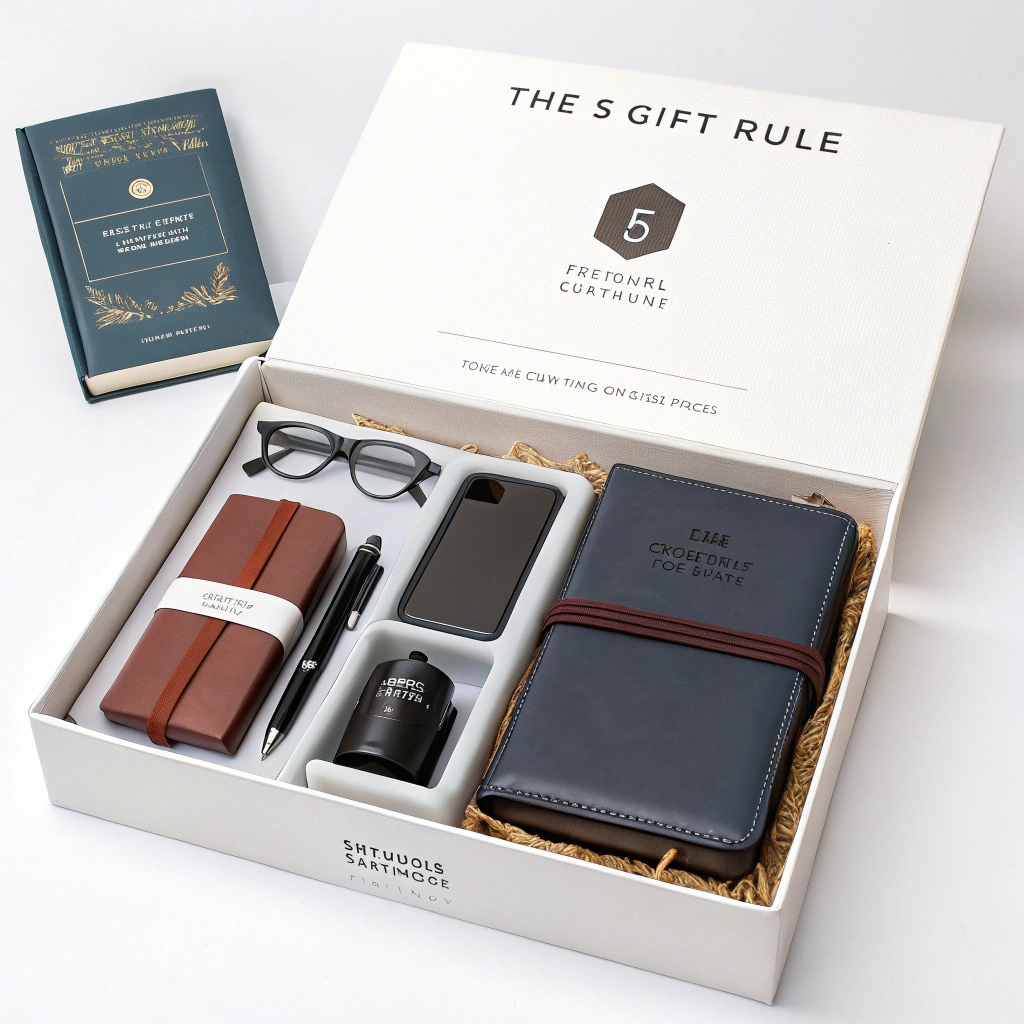
Balancing Curation and Structure
From my perspective, this rule works beautifully because it forces corporate procurement teams to practice restraint and prioritize user experience over sheer volume. Instead of filling a holiday box with cheap plastic pens and generic keychains that end up in landfills, this strategy creates a meaningful, retail-grade lifestyle experience. For example, an onboarding pack for new staff can feature a premium wireless charger (need), a sleek matte thermal mug (want), a cozy tonal embroidered hoodie (wear), a beautiful cork-covered journal (read), and a custom company mascot blind box (unexpected). This intentional pairing tells a complete brand story, improves staff morale, and ensures every item earns a permanent spot in their daily life.
Let us look at how you can apply the five-gift framework to structure a high-end employee welcome box.
The 5 Gifting Pillars | Strategic Product Choice | Primary Material Selection | Everyday Value for the Recipient |
|---|---|---|---|
1. Something They Want | Insulated Desk Mug | 304 Stainless Steel | Keeps their morning coffee hot for hours |
2. Something They Need | Multi-Port Type-C Hub | Matte Anodized Aluminum | Removes messy cable clutter from their desk |
3. Something to Wear | Minimalist Travel Pouch | Heavyweight Cotton Canvas | Organizes travel tech gear safely during trips |
4. Something to Read | A5 Ribbon-Bound Journal | Certified Recycled Paper | Tracks daily meeting notes and project goals |
5. Something Unexpected | White-Noise Pillow Speaker | Soft-Touch ABS Polymer | Supports deep relaxation and work-life balance |
What Is an Acceptable Business Gift?
Are you terrified of breaking internal corporate compliance regulations or causing an embarrassing human resource conflict with your next B2B relationship gesture? Sending an inappropriate item at the wrong time can ruin a commercial partnership completely.
An acceptable business gift is a professional, high-utility item that stays well within the recipient’s legal corporate compliance cost limits and features clean, discreet branding. Perfect choices include premium workspace tools, durable travel accessories, and retail-quality drinkware presented outside active contract bidding periods.

Navigating Professional Etiquette
When running production runs in the printing factory, I learned that following a strict technical protocol prevents highly expensive operational blunders. Professional gifting etiquette follows the exact same logic. You must never send a lavish, high-value token to a procurement manager during an active contract renewal phase, as this looks like an unethical bribe. Furthermore, branding must remain exceptionally clean and restrained. Slapping a giant, bright corporate banner across a beautiful travel pouch makes it look like a cheap billboard. Using a tiny laser engraving or blind debossing keeps the item sophisticated so your client proudly carries it into public coffee shops and boardrooms.
Let us map out what makes a corporate token acceptable versus problematic across different professional environments.
Gift Item Category | Fully Acceptable Practice | Dangerous Compliance Risk | Resulting Brand Reputation |
|---|---|---|---|
B2B Client Tokens | Subtle laser-engraved steel flasks | Expensive luxury jewelry or watches | Professional, respectful, and ethical |
Staff Rewards | Curated wellness and tech tool boxes | Unregulated cash envelopes or bonuses | High attention to detail and care |
Public Event Giveaways | Lightweight recycled canvas tote bags | Cheap, fragile plastic novelty toys | Modern, responsible, and sustainable |
What Are the Three Elements Required for a Valid Gift?
Are you looking for a clear, foundational understanding of the legal and structural boundaries that separate an authentic personal transfer of property from a standard commercial trade? Missing these core rules can lead to contract disputes.
The three elements required for a valid gift are the donor’s clear intent to transfer ownership immediately without expecting compensation, the recipient’s voluntary acceptance of the property, and the absolute physical or symbolic delivery of the item to the new owner.

The Legal and Behavioral Framework
In the custom corporate manufacturing and logistics world, understanding the clear transfer of title and property is an essential requirement for smooth corporate operations. These three criteria form the absolute core of property law and apply directly to how corporate items are managed. First, the giving business must show clear, uncoerced generosity rather than hiding a conditional trade agreement in the fine print. Second, the client must actively accept the asset, which is why checking corporate compliance limits beforehand is vital—if their policy forces a refusal, the transfer fails. Finally, the item must be physically delivered, whether that means handing over a custom rigid gift box at an annual dinner or shipping a remote team package directly to an employee’s home.
Let us break down these three mandatory pillars to ensure your upcoming distribution campaigns are fully compliant and successful.
Essential Element | Practical Corporate Meaning | Real-World Sourcing Example | Failure Impact on Campaign |
|---|---|---|---|
1. Donor Intent | Giving a token purely out of professional respect without forcing a sales quote | Dropping an end-of-year custom thank-you box to a long-term partner | Looks like a transactional transaction |
2. Donee Acceptance | The client successfully clears their internal compliance rules to receive the item | An administrative team officially logging a promotional mug into their registry | Forced return of products to supplier |
3. Clear Delivery | Moving the physical asset completely out of your company’s storage inventory | Shipping custom canvas tech pouches through a tracked courier service | Items get lost or stuck in production logs |
Conclusion
Considering business gifts effectively requires prioritizing daily recipient utility over loud branding, staying strictly within corporate compliance boundaries, and using structured curation frameworks to elevate your professional relationships successfully.