Sep 11, 2026News & Insights
Why Do Some Pens Not Work on Certain Types of Paper?
Pens may fail on certain papers due to surface coatings, ink absorption, friction, and contamination. Choosing compatible paper and ink ensures smoother writing.

Why Do Some Pens Not Work on Certain Types of Paper?
Do you get frustrated when a reliable pen suddenly skips, pools ink, or leaves smeared streaks across a new notebook? Blaming the pen alone ignores the physical friction and chemical bonding required between ink formulas and paper fibers.
Pens fail on certain papers because of mismatched surface tension, chemical coating barriers, capillary absorption rates, and mechanical ball slip caused by paper slickness or skin oil contamination.
When I started my career working in a printing factory years ago, I saw how different paper stocks interacted with inks on the press floor. A pen is only half of the mechanical equation; the paper surface acts as the receiver. If the paper’s porosity, sizing, and friction do not match the ink’s viscosity, the writing system fails. Let us examine why pens stop working on specific papers, troubleshoot skipping ballpoints, and evaluate typical pen lifespans.
Why Does My Pen Not Work on Certain Paper?
Have you ever tried writing on glossy thermal receipts, coated magazine pages, or heavily calendered luxury notebooks only to find your pen leaving dry scratches? The physical surface properties of paper dictate whether ink can physically transfer and dry.
Your pen does not work on certain paper because slick surface coatings prevent the tungsten ball from gripping and rolling, while non-porous coatings stop liquid ink from absorbing into the paper pulp.
Sizing Agents, Calendering, and Capillary Action
Paper production relies on “sizing” (chemical coatings like starch or synthetic polymers) and “calendering” (passing paper through high-pressure heated metal rollers). Unsized paper, like newsprint or blotting paper, absorbs ink rapidly through capillary action, leading to feathering and bleed-through. In contrast, heavily calendered or coated stock (like clay-coated art paper or receipt stock) seals the cellulose fibers, creating a non-porous shield.
When an oil-based ballpoint glides across an ultra-smooth, coated sheet, the tungsten carbide ball skids rather than rotates. Because ballpoint ink requires friction to roll the ball and deposit paste from the reservoir, zero traction results in immediate skipping. Gel and liquid fountain inks face the opposite issue: they roll on easily but cannot penetrate the sealed coating, sitting on top as wet puddles that smear with the slightest touch.
Paper Type | Surface Coating & Texture | Best Pen Match | Worst Pen Match | Common Writing Failure |
|---|---|---|---|---|
Ultra-Smooth Clay Coated | Non-porous, glossy mineral glaze | Oil-based ballpoint / Permanent marker | Water-based fountain / Gel pen | Severe ink smudging; zero absorption |
Standard 80 GSM Copy Paper | Semi-porous, moderate roughness | Gel pens, rollerballs, ballpoints | Wet flex-nib fountain pens | Feathering and reverse-side ghosting |
Heavy French Vellum (e.g., Clairefontaine) | Dense, hard-sized smooth satin finish | Fountain pens & rollerballs | Low-friction standard ballpoints | Ball skidding and hard skipping |
Thermal Receipt Paper | Chemically treated BPA/BPS top-coat | Permanent felt fineliner | Gel pens & fountain pens | Instant scratching, skipping, and fading |
Why Do Ballpoint Pens Stop Working?
Are you tired of scribbling aggressive circular loops on a notepad trying to revive a half-full ballpoint that abruptly quit writing? Tossing the pen in the trash is often unnecessary once you diagnose the mechanical blockage.
Ballpoint pens stop working due to skin oil contamination on the paper, dried ink crusting around the tungsten socket, air bubbles trapped in the ink column, or physical flat spots on the rolling sphere.
Mechanical Ball Jamming, Air Locks, and Oil Contamination
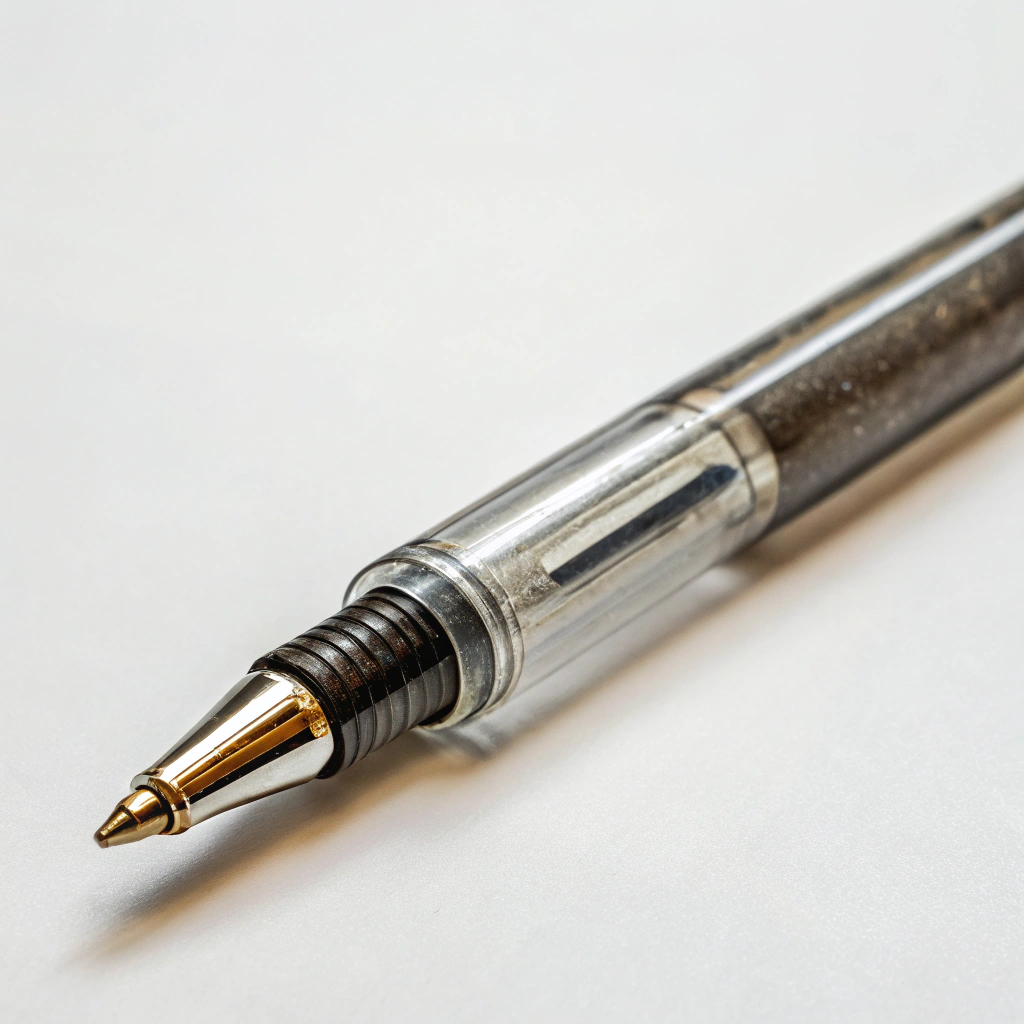
A ballpoint tip is a micro-engineered socket holding a tiny sphere (usually 0.7 mm to 1.0 mm) with tolerances under a single micron. When you write near the bottom of a journal page where your palm rested, microscopic skin sebum transfers onto the paper fibers. The ball rolls over this invisible oil slick, coats itself in grease, loses traction against the paper, and stops rotating.
Another common failure is the air lock. Storing a pen tip-up in an office cup or dropping it onto a hard floor can dislodge the thick ink column, allowing a micro-bubble of air to settle directly behind the ball. Without ink pressure feeding the socket, the pen writes dry. Crusted ink can also dry in the microscopic clearance between the ball and socket rim if left uncapped or exposed to dry air-conditioned office environments.
Failure Mechanism | Physical Root Cause | Immediate Diagnostic Sign | Practical Revival Method |
|---|---|---|---|
Sebum Oil Glaze | Resting hand oils transferred to page | Skips specifically on bottom half of page | Write on clean, raw paper or use a rubber eraser |
Internal Air Bubble | Pen stored tip-up or dropped on floor | Ink reservoir is full, but zero ink flows | Shake pen downward firmly like a clinical thermometer |
Dried Socket Crusting | Ink paste oxidized around socket rim | Scratchy initial strokes that tear paper | Dip tip in warm water (60°C) for 10 seconds or rub on rubber sole |
Damaged Socket Rim | Hard floor drop dented brass housing | Ball is locked tight and cannot spin | Mechanical failure; pen cannot be salvaged |
What Is the Average Lifespan of a Pen?
Do you wonder how much handwriting mileage you should expect from promotional pens before their ink cartridges run completely dry? Sourcing the wrong ink mechanism leads to early runouts and unhappy recipients.
The average lifespan of a pen ranges from 1,000 to 3,000 meters of continuous writing for oil-based ballpoints, 500 to 1,000 meters for gel pens, and 400 to 800 meters for liquid rollerballs.
Ink Viscosity, Reservoir Volume, and Mileage Metrics
The lifespan of a pen is measured industrially by linear writing distance rather than calendar months. Oil-based ballpoint ink consists of thick solvent-based dyes with high viscosity, meaning only a microscopic film of paste transfers onto the paper with each rotation. As a result, a standard ballpoint cartridge lasts significantly longer, often covering between two and three kilometers of continuous lines (equivalent to 50 to 70 legal notepad pages).
Gel and rollerball pens deliver a much wetter, saturated line for improved writing comfort, but they consume ink three to four times faster. Liquid rollerballs use low-viscosity aqueous ink that flows freely under gravity and capillary pull. For corporate brand managers like Jacky ordering executive gift sets, providing refillable metal pens with standardized Parker-style G2 ballpoint refills ensures clients enjoy years of dependable daily use without running out of ink mid-quarter.
Pen Delivery System | Ink Composition & Viscosity | Linear Mileage (Meters) | Average Real-World Lifespan | Shelf Life (Unopened) |
|---|---|---|---|---|
Oil-Based Ballpoint | Heavy paste resin (High viscosity) | 1,500 to 3,000 m | 6 to 18 Months of daily office notes | 3 to 5 Years |
Hybrid Low-Viscosity (e.g., Jetstream) | Blended solvent lubricant | 1,000 to 1,800 m | 4 to 9 Months of regular writing | 2 to 3 Years |
Pigment Gel Ink | Water-based thixotropic gel | 500 to 1,000 m | 2 to 4 Months of intensive use | 1.5 to 2 Years |
Liquid Ink Rollerball | Free-flowing aqueous dye | 400 to 800 m | 1 to 3 Months of heavy journaling | 1 to 1.5 Years |
Conclusion
A successful writing experience requires pairing ink viscosity with the right paper surface; matching smooth oil ballpoints to calendered sheets and porous papers to quick-drying inks ensures effortless writing across every page.